Showing posts with label YA. Show all posts

Thursday, August 20, 2015

Horcruxes: analogues and sources

As you know, I’ve be reading the Harry Potter books again. I’ve also been working on the bookshelves in my office at home. This has involved handling and arranging a large number of books, as well as sorting in all my acquisitions of the last three years or so. One book that came to the surface is something that actually belongs on our fiction bookshelves downstairs, but it’s been bobbing around in my office since the last time I read it too, close to two years ago. On that occasion, I noticed once again something I have been meaning to share since at least the previous time I had read it, some six years ago. The book I’m talking about is Lloyd Alexander’s Taran Wanderer, and if you know it, you may already see where I’m headed. It’s a subject I’ve been meaning to tackle on Lingwë for a long, long time, and I think the day has come at last — mainly because I want to be able to put the darn book back on the shelf!

So, you all know what a horcrux is — in Slughorn’s words, “an object in which a person has concealed a part of their soul. […] You split your soul, you see […], and hide part of it in an object outside your body. Then, even if one’s body is attacked or destroyed, one cannot die, for part of the soul remains earthbound and undamaged” [1].

There’s a long tradition of the external soul in folktales, and I’ll come back to that in a little while, but first, consider an episode in Taran Wanderer (1967), the fourth book in Lloyd Alexander’s Prydain Chronicles. This is a series, like Harry Potter, that I’ve read many times, and as I said, I made this connection between them some years ago. I can’t remember exactly when now, but I’m guessing it was 2009, or perhaps even a year or two before that.

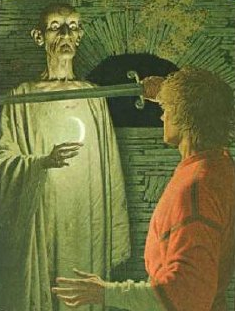
Without going over the plot of the entire novel (for which, see here), let’s get right to the episode in question (spoilers, obviously!). In a nutshell: Taran and his companions encounter Morda, an evil wizard who has separated his soul from his body and placed it into a small shard of bone, his own severed pinky bone, in fact. With his soul elsewhere, the wizard is now as strong as death and cannot be killed like a mortal man. But as luck (or providence) would have it, Taran has come across this bone. To save the lives of his companions and himself, he tries to snap the bone in half. He can’t do it, but in Morda’s struggle to regain the bone, it does indeed snap and Morda is undone. It’s a memorable scene in a great novel for young people.

Now let’s take a closer look at some of the details here. Apologies if this is a bit lengthy, but there are a number of points I want to call your attention to.

Taran and friends find a small iron coffer, bound in iron bands, and padlocked. Rather recklessly, they break into the coffer, finding a leather pouch containing “a slender piece of bone as long as Taran’s little finger” [2]. Taran’s companion, Fflewddur Fflam, is all for getting rid of it as a dangerous enchantment — quite sensibly. They return it to the coffer, and return that to the hiding place where it was hidden in a hollow tree. But a few pages later, it turns out that Taran’s pet crow, Kaw, has retrieved it, magpie-like, and brought it back to Taran for a prank. Fearing to toss it away now, Taran pockets it. Meanwhile, the companions come upon their friend Doli, who has been transformed into a frog by Morda and left to die.

Eiddileg, King of the Fair Folk, sent to Doli to investigate the theft of one of their treasure troves, and when he was discovered, Morda cast a spell on the dwarf to get rid of him. Casting an enchantment on the Fair Folk was a thing completely unheard of, for which Doli calls “the foul villain of a wizard […] shrewder than a serpent” — the choice to transform Doli into a frog might be relevant here, as frogs are serpent’s prey. Morda mocked him and “savored [his] lingering agony more than the mercy of killing him out of hand” [3].

Seeing no other way to reverse the enchantment cast against Doli, Taran, with Gurgi and Kaw, decides to confront Morda. Morda’s dwelling is surrounded by a great wall of thorns, and Kaw is ensnared seeking a way around or over. Taran and Gurgi attempt to climb the wall, but they too are captured, and Fflewddur likewise, not long after. Morda has “a gaunt face the color of dry clay, eyes glittering like cold crystals, deep set in a jutting brow as though at the bottom of a well. The skull was hairless, the mouth a livid scar stitched with wrinkles.” “Morda’s gaze was unblinking. Even in the candle flame the shriveled eyelids never closed […].” His voice is likened to the hiss of a serpent, and “[t]he glint in Morda’s lidless eyes flickered like a serpent’s tongue.” With a magical ornament that he stole, a gem of great power, Morda transforms Fflewddur and Gurgi into a rabbit and a mouse respectively (note: also serpent’s prey), finally rounding on Taran, who “stared at the ornament like a bird fascinated by a serpent.” Later, as they struggle, “the wizard’s relentless grip tightened,” much like a python’s.

Gurgi, in mouse form, gnaws loose the ropes binding Taran. Freed, Taran runs Morda through with his sword — to absolutely no avail whatsoever. But then Taran sees that Morda is missing a finger, and he realizes that this is the very bone he pocketed. Morda has already revealed he had been seeking ways to extend his life. This is the reason he plundered the Fair Folk’s trove, searching for gemstones to lengthen his life beyond “any mortal’s mayfly span of days.” With Angharad’s magical ornament he has learned even to cheat death. “My life is not prisoned in my body. No, it is far from here, beyond the reach of death itself!” he says to Taran. “I have drawn out my very life, hidden it safely where none shall ever find it. Would you slay me? Your hope is useless as the sword you hold.”

Morda attempts to transform Taran, but surprisingly, the spell fails. Taran is not enchanted; something is blocking the spell. Taran has realized the value of the little bone Kaw brought back to him, and Morda has realized that Taran holds his life in his hands. In the ensuing struggle, the bone is finally snapped in two, and “[w]ith a horrible scream that stabbed through the chamber, Morda toppled backward, stiffened, clawed the air, then fell to the ground like a pile of broken twigs.”

Whew! That ran on a bit, didn’t it? But I wanted to point out some important features of this episode. First, and perhaps most obvious is the strong similarity between the finger bone containing Morda’s soul, protecting him from death, and Voldemort’s horcruxes, each serving the same purpose. None of Voldemort’s horcruxes are parts of himself, though you might remember that when the younger Barty Crouch kills his father, “I Transfigured my father’s body. He became a bone … I buried it while wearing the Invisibility Cloak, in the freshly dug earth in front of Hagrid’s cabin” [4]. An incidental similarity, but an interesting one. Another similarity of this same sort and from the same installment of Harry Potter: Morda sacrifices a finger in his quest for immorality much as Pettigrew sacrifices a hand to serve’s Voldemort’s; and likewise, another of the ingredient’s in Voldemort’s return is a bone of his father, straight from his grave.

There is also the significant amount of ophidian imagery shared by Morda and Voldemort, much of which I’ve highlighted above. Both characters are frequently compared to snakes (more so than to anything else), both have unblinking eyes and other features like a serpent, both speak in a hiss.

Along with their occupations (unstoppable evil wizards), their names are quite similar too. I’ve written about the name Voldemort before (you can read that here). Morda clearly reveals the same root, the Latin mors “death”. In his Author’s Note, Lloyd Alexander refers to him as “deathlike”, offering as good a gloss of the name as we need! Oh and did I say unstoppable? In both cases, Voldemort and Morda are respectively stymied in their attempts to curse the protagonist of the story. Harry is protected by Lily’s love and becomes part-horcrux himself; and because he is part-horcrux, it is that horcrux that Voldemort destroys — not Harry himself — with the Avada Kedavra curse during the Battle of Hogwarts. Not unlike the way Taran is protected because he holds Morda’s life in his hands. Morda is also described as “gaunt”, and Potter fans need no reminder that the same word has great significance for Voldemort too.

So, quite similar in many way, yes? But none of this is to suggest Rowling got the idea of horcruxes from Lloyd Alexander! I have no idea whether she’s ever read his work, and in any case, Alexander himself notes in his Author’s Note to Taran Wanderer that “Morda’s life secret […] is familiar in many mythologies.” Rather, both Rowling and Alexander each independently borrowed an idea familiar to them from folklore for their own use.

Tolkien touches on the motif of the external soul in his essay “On Fairy-stories”. Discussing The Monkey’s Heart, a Swahili tale Andrew Lang included in his Lilac Fairy Book, Tolkien writes:
I suspect that its inclusion in a ‘Fairy Book’ is due not primarily to its entertaining quality, but precisely to the monkey’s heart supposed to have been left behind in a bag. That was significant to Lang, the student of folk-lore, even though this curious idea is here used only as a joke; for, in this tale, the monkey’s heart was in fact quite normal and in his breast. None the less this detail is plainly only a secondary use of an ancient and very widespread folk-lore notion, which does occur in fairy-stories;* the notion that the life or strength of a man or creature may reside in some other place or thing; or in some part of the body (especially the heart) that can be detached and hidden in a bag, or under a stone, or in an egg. At one end of recorded folk-lore history this idea was used by George MacDonald in his fairy-story The Giant’s Heart, which derives this central motive (as well as many other details) from well-known traditional tales.

* [Tolkien’s footnote:] Such as, for instance: The Giant that had no Heart in Dasent’s Popular Tales from the Norse; or The Sea-Maiden in Campbell’s Popular Tales of the West Highlands (no. iv, cf. also no. i); or more remotely Die Kristallkugel in Grimm.
This is the same motif seen with Morda’s finger bone and with Voldemort’s horcruxes. I included Tolkien’s footnote in the quotation, because Die Kristallkugel [“The Crystal Ball”] also presents an additional layer of similarity to Lloyd Alexander. In the tale, an enchanter’s power is hidden in an external object, and three brothers confront this wizard attempting to rescue a princess. Two of them have been transformed into animals, an eagle and a whale. All of these motifs resonate closely with the episode in Taran Wanderer.

Tolkien goes on to give an even earlier example:
At the other end, indeed in what is probably one of the oldest stories in writing, it occurs in The Tale of the Two Brothers on the Egyptian D’Orsigny [sic; D’Orbiney] papyrus. There the younger brother says to the elder: ‘I shall enchant my heart, and I shall place it upon the top of the flower of the cedar. Now the cedar will be cut down and my heart will fall to the ground, and thou shalt come to seek for it, even though thou pass seven years in seeking it; but when thou has found it, put it into a vase of cold water, and in very truth I shall live.’
The motif is once again similar, and this time, the hiding place is a tree, just in in Lloyd Alexander. And of course, in traditional tales of two and three wizard brothers, we hear an echo of Rowling’s “Tale of the Three Brothers” from The Tales of Beedle the Bard. That tale doesn’t make use of the external soul motif directly, but of course, each of the three brothers in the parable seeks to escape or delay death, just as do Voldemort and Morda. And their Deathly Hallows are set up as talismans contrasting directly with Voldemort’s horcruxes.

Another interesting story of this same sort is the Slavic tale of Koschei, included by Andrew Lang in his Red Fairy Book as “The Death of Koschei the Deathless”. Again the tale involves wizards, three of them, not brothers this time, but each married to one of three sisters. Each can transform into a bird of prey, so we have animal transformations once again. Koschei is another enchanter, one who has protected himself from death by hiding his soul inside a needle (rather like Morda’s bone), and that in turn inside an egg, which is inside a duck, inside a hare, locked in an iron chest, which is buried under an oak tree. That is six levels of external protection, just like Voldemort’s six (intentional) horcruxes.

And there are plenty more analogues we might examine! Sir James Frazer surveys the sources rather exhaustively in his mammoth study of magic and religion, The Golden Bough. See Chapter X “The External Soul in Folk-tales” (pp. 95–152) in Volume 11 of the third edition, called Balder the Beautiful: The Fire-Festivals of Europe and the Doctrine of the Eternal Soul, Volume II (published 1913). Frazer finds this motif in the traditional tales of Hindu, Kashmiri, Greek, Italian, Slavic, Lithuanian, German, Scandinavian, Celtic, Egyptian, Arabic, and many other peoples. The basis for their many stories, Frazer argues, was a genuine belief in this principle by primitive peoples.

So Alexander and Rowling are clearly dipping into the same well here, and a very deep one. There is no reason at all to suppose Rowling borrowed from Alexander, and yet the striking similarities between their tales — both dark wizards likened repeatedly to a serpent, both with names meaning “death”, both of whose attempts to curse the protagonist fail — certainly do catch the eye! That these are logical enough characteristics for such a character and could easily occur to authors independently needn’t spoil the fun of dwelling on them. What do you think?


[1] Rowling, J.K. Harry Potter and the Half-Blood Prince. New York: Arthur A. Levine Books [an imprint of Scholastic], 2005, p. 497.

[2] Alexander, Lloyd. Taran Wanderer. New York: Holt, Rinehart and Winston, 1967, p. 91.

[3] Ibid., p. 101–2. Subsequent quotations from Taran Wanderer follow along through this chapter and the next, passim.

[4] Rowling, J.K. Harry Potter and the Goblet of Fire. New York: Arthur A. Levine Books [an imprint of Scholastic], 2000, p. 690–1.

Tuesday, November 13, 2007

Lloyd Alexander, before Prydain

Before Prydain, there was Time Cat, Lloyd Alexander’s first foray into fantasy fiction for young people (and a very entertaining read), but before that, Alexander wrote several memoirs which are all out of print and pretty difficult to find. Growing up, I can remember seeing them atop the flyleaf “Also By” list again and again: And Let the Credit Go (1955), My Five Tigers (1956), Janine is French (1959). I always wondered about these books, but I could never find one. And it’s gotten still more difficult. Recent searches on Bookfinder show that Alexander’s first published book, And Let the Credit Go, will set you back quite a bit of your own credit: anywhere from $90 on up to more than $300! Janine is French goes for upwards of $65; but My Five Tigers, at least, you can get for an affordable price: $15 and up.

So imagine my surprise when I came across a copy of My Five Tigers at Half Price Books recently. In fact, it was an original hardcover, published by Thomas Y. Crowell in 1956, with a pristine dust jacket identifying the copy as a second printing. Also interesting is the fact that, as a pre-Prydain book, the dust jacket blurbs talk Alexander up for his translations and memoirs alone, which offers a very interesting, and very different perspective on the man who would later become so famous for his fantasy. So, altogether a fantastic copy in rare condition for its age (just over fifty years old). The price? $3.00. No, I’m not kidding! Is that good fortune smiling down on me, or what?!

The book is a wonderful read, especially for fans of Lloyd Alexander, cats, humorous memoirs — or all three. The books is also charmingly illustrated by Peggy Bacon. In it, Alexander recounts how he became a “cat person” (a reluctant one at first) after returning to America with his new (French) wife, Janine in 1946. Settling in Philadelphia:
That first spring, while Janine set about getting the house in livable shape, I undertook to find a pet. Naturally, I chose a dog: an eight-months puppy from the local animal refuge. I named him Barkis — Barkis the Unwilling — and his conduct was enough to try the patience of the most unshakable dog-lover [...] One day he ran off and never came back. (p.2)
So, at Janine’s urging, they turned to cats. And over the ensuing 120 pages, Alexander recounts the adventures of daily life with their first five felines: Rabbit, Heathcliff, David, Solomon, and Moira (the only female). Each has his (or her) own unique personality, hangups, entertainments, and habits. All of it is delightfully shared with readers. (There is one sad story, but I will say no more than that.) The other thing I should point out is how well-written the book is. Alexander fans will know (and I wrote about this recently) that as good as his novels are, they can begin to feel a little — how shall I put this? — stale? recycled? Again, I mean only the gentlest criticism by this. But My Five Tigers feels very fresh and original! There are very few of the “Alexanderisms” we’ve all come to recognize (e.g., “vexed”, “took to his heels”, “his head swam”, “into the bargain” — sound familiar?).

Also, attentive readers might notice a few images that pop up again in Alexander’s fiction. For example, Rabbit likes to curl up next to an old Irish harp and occasionally pluck at the strings (p.7) — perhaps this helped Alexander to envision the relationship between Fflewddur Fflam and the great mountain cat, Llyan, for The Castle of Llyr. And then there’s the image of Alexander practicing the violin, the noise of which Heathcliff could not tolerate — “Balancing himself on his hind feet, he reached up and sank his claws into my knees. The more I played, the harder he scratched” (p.35). I can’t help but picture Sebastian and Presto from The Marvelous Misadventures of Sebastian.

So, if you can get your paws on it, look for My Five Tigers. It’s a charming, wonderfully entertaining (and short), book. Alexander fans will simply devour it like so much catnip. And now — any of you have a copy of And Let the Credit Go or Janine is French you could lend out? :)

Wednesday, November 7, 2007

Tesser well, good readers!

As many of you know, Madeleine L’Engle died only two months ago, not long after Lloyd Alexander’s passing; and so, thinking about all the books I had enjoyed as a child, I decided I would read A Wrinkle in Time again — for only the second time since I first read it some twenty-five (or more?) years ago. The fog of those years had left me with only a few very vague memories of the book, and even those dim recollections were superseded in my mind by images from a Wrinkle in Time filmstrip I can remember seeing in elementary or early junior high school. And now that I’ve read it again, it turns out that some of things I’d remembered must have been from A Wind in the Door or A Swiftly Tilting Planet and not from Wrinkle at all.

Also, interestingly, the library copy I picked up was — in addition to suffering from major water damage and a splitting spine — autographed. “For Heather Winslow,” the neatly penned inscription reads, “Tesser well — Madeleine L’Engle.” When I return it to the library, I’ll have to make sure they know it’s a bit more valuable than they may have thought. I could see a book in its condition landing in the landfill, actually.

So. Impressions.

First, I have to say, at the risk of turning off some readers or offending any big L’Engle fans, that the book is much more obvious and treacly than I remembered. Perhaps this is because it really is genuinely intended for children (as opposed to some books usually classified “for children” but actually suitable for readers of all ages). Its lessons are rather facile and are delivered by a heavy hand wielding a pretty blunt instrument. Not to be insensitive, but it isn’t terribly surprising that the book was rejected by 26 publishers before it finally found a home at Farrar, Straus & Giroux. But it went on to win the 1963 Newberry Award — and made its creator a celebrity of children’s literature — so what do I know? ;)

But setting these complaints aside, the book is enjoyable and interesting overall. The settings and situations are pretty creative, and the characters are appealing. Camazotz and IT are suitably unnerving. Aunt Beast is still a remarkable, inscrutable character. And Charles Wallace is still an enigma, even after all these years. The three angels qua witches — Mrs. Whatsit, Mrs. Who, and Mrs. Which (> Witch, get it? :) — are intriguing. Think of a reverse image of the three Weird Sisters of Macbeth (in fact, Mrs. Who makes the comparison and contrast an obvious one, quoting those famous lines: “When shall we three meet again, / In thunder, lightning, or in rain.” The novel even opens with those famous, and nowadays all too banal, words, “It was a dark and stormy night.” But somehow, here, it works.

There were a couple of things I noticed this time, which I would not have on my first reading. For one, Mrs. Whatsit, some of you may remember, had once been a Star who sacrificed herself in the struggle with the Black Thing. Reading this now, I wonder whether this is a direct borrowing from C.S. Lewis. In The Voyage of the Dawn Treader, the character of Ramandu had likewise once been a Star. Wrinkle was published only a decade after Dawn Treader, and both authors were well known Christian allegorists, so it seems a plausible connection.

Another thing I noticed this time was the sonnet analogy (in my copy, pp.191–2). Mrs. Whatsit tangles with the perennial question of free will versus predestination versus the omniscience of God, much as Lewis did in The Screwtape Letters. Her argument amounts to this: the sonnet form itself is a very strict, very rigid structure, comprising various unforgiving rules of rhyme and rhythm; however, within the constraints of the form, the poet is free to choose whatever words he or she likes. This resonates well with the idea that Lewis (and Tolkien, too) tried to convey of a system where both omniscience and free will are compatible. Put another way, the relationship between providence and free will is perhaps like chess: God makes the rules, but Man is free to choose any moves allowed by the rules. Some choices lead to victory, some to defeat, and some to a draw. Though not a religious person myself, I liked the simplicity of the sonnet analogy very much.

Thursday, September 13, 2007

Other books for Potterphiles

So now that J.K. Rowling has brought the Harry Potter series to a close (notwithstanding the possibility of future add-ons, such as the Potter Encyclopedia she has hinted at), what else are Potterphiles to turn to? I thought I would take a moment to recommend some of the books and series I have read and enjoyed myself — mainly in the domain of YA Fantasy. These are all books I’ve read myself, so it is this more than anything else which accounts for obvious omissions (e.g., the Xanth series of Piers Anthony, the Pern books of Anne McCaffrey, or Susan Cooper’s Dark is Rising series — they may all be great, but I wouldn’t know, never having read them myself). The list is also, by necessity, selective. I read a lot, but I obviously can’t put down everything here in a single post. So, take this for what it’s worth: it’s just one man’s opinion, and only part of it.

Lloyd Alexander
Alexander (who passed away very recently) is best known for his Prydain Cycle, five novels (plus a couple of add-ons) that take as their rough inspiration the Wales of the Mabinogion. These are wonderful, of course, but Alexander has dozens of other books to offer famished readers as well. There are the Vesper Holly and Westmark series, as well as many individual books worth reading, such as The Marvelous Misadventures of Sebastian, The First Two Lives of Lukas-Kasha, and Time Cat — and the posthumous Golden Dream of Carlo Chuchio, published only last month. I’ve read almost everything Alexander wrote and can recommend all of it without reservation.

Isaac Asimov
The Foundation Trilogy. This is only the “science-fiction” on an otherwise exclusively fantasy-centered list, but I include it for two reasons: a) it’s not really conventional science-fiction, in the sense of, say, Stanisław Lem or Arthur C. Clarke), and b) the sheer scope of the imagination involved is enough to earn it a place here. Asimov did publish a lot of mainstream sci-fi, and there are also a number of add-on books in the Foundation series (which I haven’t read). These three, however, are remarkable, and will give you a whole new appreciation for the idea of “hacking history”. In fact, the science of psychohistory, as propounded in the novel, may make you think of Stanisław Lem — or Aldous Huxley perhaps.

Neil Gaiman
I’m thinking of three books in particular: Stardust, American Gods, and Anansi Boys. The latter two are related through a minor character, the African Spider-god, Anansi. Immensely imaginative, entertaining, and actually quite funny in places, all three are rewarding in their own ways. Plus, reading Gaiman makes you “cool”. ;)

Alan Garner
Garner wrote two Alderley Edge novels, The Weirdstone of Brisingamen and The Moon of Gomrath (of which, the first is definitely the better), as well a number of wonderful individual novels — The Owl Service (like Alexander, with a nod to the Mabinogion), Elidor, Red Shift, and the more difficult Strandloper. Like Tolkien, Garner drew on a combination of local (Cheshire) history and Germanic and Celtic mythologies for his fiction. Almost forgotten today, though I don’t really know why, Garner is well worth discovering.

Madeleine L’Engle
L’Engle passed away only a week ago, and it’s another devastating loss, following right on the heels of Alexander’s passing. I haven’t read a lot of her work, but I did read three of the four books in the Time Quartet (the fourth book came too long after). They were incredibly eye-opening for me — they’re the reason I could throw around words like “mitochondria” and “tesseract” at the tender age of ten or so. I also have fond memories of watching the Wrinkle in Time filmstrip (yes, filmstrip — remember those? :) in elementary school.

Ursula K. Le Guin
The Earthsea Trilogy was a special favorite of mine, growing up, and I reread it earlier this year. Read it — you won’t be sorry! Like Tolkien, Le Guin shows a special appreciation for the power of words, names, and language. Le Guin eventually wrote several add-on books (of which I didn’t especially enjoy Tehanu; though The Other Wind was excellent). Le Guin is also a master (err, mistress?) of the fantasy / science-fiction short story. Her collection The Wind’s Twelve Quarters is definitely worth making time for.

C.S. Lewis
I only read The Chronicles of Narnia at the embarrassing late date of, err, earlier this year. And while they do have their defects, they were incredibly influential (they still are), and they really are great fun to read. I could include the Space Trilogy here, but for the fact that I haven’t read it yet. Also, I don’t think it’s quite meant for the YA audience (just as Lewis’s superb novel, Till We Have Faces, is not).

Byron Preiss / Michael Reeves
Dragonworld was a great discovery for me in the early 1980’s. In some ways, it owes a large debt to Tolkien — e.g., its main character, Amsel, is a small person, very much like a Hobbit; however, it’s a world away from the rip-off work of Terry Brooks. Plus, it’s long and copiously illustrated; it’s the kind of book that you can luxuriate it. And it has some quite original ideas, too. Look for it. Sadly, Preiss was killed a couple of years ago in a car crash, a year or two after filing bankruptcy. :(

Philip Pullman
Owing an enormous debt to Milton, Pullman’s His Dark Materials trilogy (with the add-on, Lyra’s Oxford, and the forthcoming Book of Dust) is one of the most imaginative series of recent years. The books aren’t without their faults, but they’re probably the most inventively mythopoeic works since Tolkien and Lewis — despite Pullman’s vociferous dislike of those two. I’m looking forward to the film version of The Golden Compass.

J.R.R. Tolkien
What do I really need to say? If you haven’t read The Hobbit and The Lord of the Rings, isn’t it about time? :)

Walter Wangerin, Jr.
Wangerin is, like Lewis, a Christian apologist, but one who brooks no apologies for the disturbing nature of some aspects of the mythology. I’m thinking here of the duology of The Book of the Dun Cow and The Book of Sorrows. Owing a good deal to Celtic and Germanic mythology, Chaucer, Milton, and of course, The Bible, these books are Christian allegories told from the point of view of animals (before the arrival of Man on Earth). They are, for Christianity, what Orwell’s Animal Farm was for political ideology. The relationship between Chaunticleer and Mundo Cani is one of the more original in YA literature, and it forms the bridge to the sequel, which is (I must warn you) one of the single most depressing books you will ever read. But what did you expect from something called The Book of Sorrows?

John White
Okay, I should preface this recommendation with a caveat lector: John White’s Archives of Anthropos series is a very obvious Christian allegory and borrows pretty transparently from The Chronicles of Narnia, only published a couple of decades before. I really enjoyed the two I read as a kid — The Tower of Geburah and The Iron Scepter (which also borrows Dante’s conception of Hell from Inferno) — but I haven’t read them since. Having now read their inspiration in Lewis, I can see the obvious connections. The stories involve a group of children who get sucked into an alternate world, not through a wardrobe but through some strange old televisions in an abandoned attic (not unlike the method of ingress into Narnia in The Voyage of the Dawn Treader). Character and place-names owe a lot to New Testament Greek: The World of Anthropos (ανθρωπος), Castle Authentio (αυθεντικός), King Kardia (καρδιά) — and a koine rubric of “love” that is straight from Lewis’s The Four Loves. But they were fun books to read.

What can any of you recommend?