Showing posts with label George MacDonald. Show all posts

Thursday, August 20, 2015

Horcruxes: analogues and sources

As you know, I’ve be reading the Harry Potter books again. I’ve also been working on the bookshelves in my office at home. This has involved handling and arranging a large number of books, as well as sorting in all my acquisitions of the last three years or so. One book that came to the surface is something that actually belongs on our fiction bookshelves downstairs, but it’s been bobbing around in my office since the last time I read it too, close to two years ago. On that occasion, I noticed once again something I have been meaning to share since at least the previous time I had read it, some six years ago. The book I’m talking about is Lloyd Alexander’s Taran Wanderer, and if you know it, you may already see where I’m headed. It’s a subject I’ve been meaning to tackle on Lingwë for a long, long time, and I think the day has come at last — mainly because I want to be able to put the darn book back on the shelf!

So, you all know what a horcrux is — in Slughorn’s words, “an object in which a person has concealed a part of their soul. […] You split your soul, you see […], and hide part of it in an object outside your body. Then, even if one’s body is attacked or destroyed, one cannot die, for part of the soul remains earthbound and undamaged” [1].

There’s a long tradition of the external soul in folktales, and I’ll come back to that in a little while, but first, consider an episode in Taran Wanderer (1967), the fourth book in Lloyd Alexander’s Prydain Chronicles. This is a series, like Harry Potter, that I’ve read many times, and as I said, I made this connection between them some years ago. I can’t remember exactly when now, but I’m guessing it was 2009, or perhaps even a year or two before that.

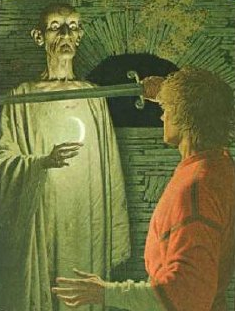
Without going over the plot of the entire novel (for which, see here), let’s get right to the episode in question (spoilers, obviously!). In a nutshell: Taran and his companions encounter Morda, an evil wizard who has separated his soul from his body and placed it into a small shard of bone, his own severed pinky bone, in fact. With his soul elsewhere, the wizard is now as strong as death and cannot be killed like a mortal man. But as luck (or providence) would have it, Taran has come across this bone. To save the lives of his companions and himself, he tries to snap the bone in half. He can’t do it, but in Morda’s struggle to regain the bone, it does indeed snap and Morda is undone. It’s a memorable scene in a great novel for young people.

Now let’s take a closer look at some of the details here. Apologies if this is a bit lengthy, but there are a number of points I want to call your attention to.

Taran and friends find a small iron coffer, bound in iron bands, and padlocked. Rather recklessly, they break into the coffer, finding a leather pouch containing “a slender piece of bone as long as Taran’s little finger” [2]. Taran’s companion, Fflewddur Fflam, is all for getting rid of it as a dangerous enchantment — quite sensibly. They return it to the coffer, and return that to the hiding place where it was hidden in a hollow tree. But a few pages later, it turns out that Taran’s pet crow, Kaw, has retrieved it, magpie-like, and brought it back to Taran for a prank. Fearing to toss it away now, Taran pockets it. Meanwhile, the companions come upon their friend Doli, who has been transformed into a frog by Morda and left to die.

Eiddileg, King of the Fair Folk, sent to Doli to investigate the theft of one of their treasure troves, and when he was discovered, Morda cast a spell on the dwarf to get rid of him. Casting an enchantment on the Fair Folk was a thing completely unheard of, for which Doli calls “the foul villain of a wizard […] shrewder than a serpent” — the choice to transform Doli into a frog might be relevant here, as frogs are serpent’s prey. Morda mocked him and “savored [his] lingering agony more than the mercy of killing him out of hand” [3].

Seeing no other way to reverse the enchantment cast against Doli, Taran, with Gurgi and Kaw, decides to confront Morda. Morda’s dwelling is surrounded by a great wall of thorns, and Kaw is ensnared seeking a way around or over. Taran and Gurgi attempt to climb the wall, but they too are captured, and Fflewddur likewise, not long after. Morda has “a gaunt face the color of dry clay, eyes glittering like cold crystals, deep set in a jutting brow as though at the bottom of a well. The skull was hairless, the mouth a livid scar stitched with wrinkles.” “Morda’s gaze was unblinking. Even in the candle flame the shriveled eyelids never closed […].” His voice is likened to the hiss of a serpent, and “[t]he glint in Morda’s lidless eyes flickered like a serpent’s tongue.” With a magical ornament that he stole, a gem of great power, Morda transforms Fflewddur and Gurgi into a rabbit and a mouse respectively (note: also serpent’s prey), finally rounding on Taran, who “stared at the ornament like a bird fascinated by a serpent.” Later, as they struggle, “the wizard’s relentless grip tightened,” much like a python’s.

Gurgi, in mouse form, gnaws loose the ropes binding Taran. Freed, Taran runs Morda through with his sword — to absolutely no avail whatsoever. But then Taran sees that Morda is missing a finger, and he realizes that this is the very bone he pocketed. Morda has already revealed he had been seeking ways to extend his life. This is the reason he plundered the Fair Folk’s trove, searching for gemstones to lengthen his life beyond “any mortal’s mayfly span of days.” With Angharad’s magical ornament he has learned even to cheat death. “My life is not prisoned in my body. No, it is far from here, beyond the reach of death itself!” he says to Taran. “I have drawn out my very life, hidden it safely where none shall ever find it. Would you slay me? Your hope is useless as the sword you hold.”

Morda attempts to transform Taran, but surprisingly, the spell fails. Taran is not enchanted; something is blocking the spell. Taran has realized the value of the little bone Kaw brought back to him, and Morda has realized that Taran holds his life in his hands. In the ensuing struggle, the bone is finally snapped in two, and “[w]ith a horrible scream that stabbed through the chamber, Morda toppled backward, stiffened, clawed the air, then fell to the ground like a pile of broken twigs.”

Whew! That ran on a bit, didn’t it? But I wanted to point out some important features of this episode. First, and perhaps most obvious is the strong similarity between the finger bone containing Morda’s soul, protecting him from death, and Voldemort’s horcruxes, each serving the same purpose. None of Voldemort’s horcruxes are parts of himself, though you might remember that when the younger Barty Crouch kills his father, “I Transfigured my father’s body. He became a bone … I buried it while wearing the Invisibility Cloak, in the freshly dug earth in front of Hagrid’s cabin” [4]. An incidental similarity, but an interesting one. Another similarity of this same sort and from the same installment of Harry Potter: Morda sacrifices a finger in his quest for immorality much as Pettigrew sacrifices a hand to serve’s Voldemort’s; and likewise, another of the ingredient’s in Voldemort’s return is a bone of his father, straight from his grave.

There is also the significant amount of ophidian imagery shared by Morda and Voldemort, much of which I’ve highlighted above. Both characters are frequently compared to snakes (more so than to anything else), both have unblinking eyes and other features like a serpent, both speak in a hiss.

Along with their occupations (unstoppable evil wizards), their names are quite similar too. I’ve written about the name Voldemort before (you can read that here). Morda clearly reveals the same root, the Latin mors “death”. In his Author’s Note, Lloyd Alexander refers to him as “deathlike”, offering as good a gloss of the name as we need! Oh and did I say unstoppable? In both cases, Voldemort and Morda are respectively stymied in their attempts to curse the protagonist of the story. Harry is protected by Lily’s love and becomes part-horcrux himself; and because he is part-horcrux, it is that horcrux that Voldemort destroys — not Harry himself — with the Avada Kedavra curse during the Battle of Hogwarts. Not unlike the way Taran is protected because he holds Morda’s life in his hands. Morda is also described as “gaunt”, and Potter fans need no reminder that the same word has great significance for Voldemort too.

So, quite similar in many way, yes? But none of this is to suggest Rowling got the idea of horcruxes from Lloyd Alexander! I have no idea whether she’s ever read his work, and in any case, Alexander himself notes in his Author’s Note to Taran Wanderer that “Morda’s life secret […] is familiar in many mythologies.” Rather, both Rowling and Alexander each independently borrowed an idea familiar to them from folklore for their own use.

Tolkien touches on the motif of the external soul in his essay “On Fairy-stories”. Discussing The Monkey’s Heart, a Swahili tale Andrew Lang included in his Lilac Fairy Book, Tolkien writes:
I suspect that its inclusion in a ‘Fairy Book’ is due not primarily to its entertaining quality, but precisely to the monkey’s heart supposed to have been left behind in a bag. That was significant to Lang, the student of folk-lore, even though this curious idea is here used only as a joke; for, in this tale, the monkey’s heart was in fact quite normal and in his breast. None the less this detail is plainly only a secondary use of an ancient and very widespread folk-lore notion, which does occur in fairy-stories;* the notion that the life or strength of a man or creature may reside in some other place or thing; or in some part of the body (especially the heart) that can be detached and hidden in a bag, or under a stone, or in an egg. At one end of recorded folk-lore history this idea was used by George MacDonald in his fairy-story The Giant’s Heart, which derives this central motive (as well as many other details) from well-known traditional tales.

* [Tolkien’s footnote:] Such as, for instance: The Giant that had no Heart in Dasent’s Popular Tales from the Norse; or The Sea-Maiden in Campbell’s Popular Tales of the West Highlands (no. iv, cf. also no. i); or more remotely Die Kristallkugel in Grimm.
This is the same motif seen with Morda’s finger bone and with Voldemort’s horcruxes. I included Tolkien’s footnote in the quotation, because Die Kristallkugel [“The Crystal Ball”] also presents an additional layer of similarity to Lloyd Alexander. In the tale, an enchanter’s power is hidden in an external object, and three brothers confront this wizard attempting to rescue a princess. Two of them have been transformed into animals, an eagle and a whale. All of these motifs resonate closely with the episode in Taran Wanderer.

Tolkien goes on to give an even earlier example:
At the other end, indeed in what is probably one of the oldest stories in writing, it occurs in The Tale of the Two Brothers on the Egyptian D’Orsigny [sic; D’Orbiney] papyrus. There the younger brother says to the elder: ‘I shall enchant my heart, and I shall place it upon the top of the flower of the cedar. Now the cedar will be cut down and my heart will fall to the ground, and thou shalt come to seek for it, even though thou pass seven years in seeking it; but when thou has found it, put it into a vase of cold water, and in very truth I shall live.’
The motif is once again similar, and this time, the hiding place is a tree, just in in Lloyd Alexander. And of course, in traditional tales of two and three wizard brothers, we hear an echo of Rowling’s “Tale of the Three Brothers” from The Tales of Beedle the Bard. That tale doesn’t make use of the external soul motif directly, but of course, each of the three brothers in the parable seeks to escape or delay death, just as do Voldemort and Morda. And their Deathly Hallows are set up as talismans contrasting directly with Voldemort’s horcruxes.

Another interesting story of this same sort is the Slavic tale of Koschei, included by Andrew Lang in his Red Fairy Book as “The Death of Koschei the Deathless”. Again the tale involves wizards, three of them, not brothers this time, but each married to one of three sisters. Each can transform into a bird of prey, so we have animal transformations once again. Koschei is another enchanter, one who has protected himself from death by hiding his soul inside a needle (rather like Morda’s bone), and that in turn inside an egg, which is inside a duck, inside a hare, locked in an iron chest, which is buried under an oak tree. That is six levels of external protection, just like Voldemort’s six (intentional) horcruxes.

And there are plenty more analogues we might examine! Sir James Frazer surveys the sources rather exhaustively in his mammoth study of magic and religion, The Golden Bough. See Chapter X “The External Soul in Folk-tales” (pp. 95–152) in Volume 11 of the third edition, called Balder the Beautiful: The Fire-Festivals of Europe and the Doctrine of the Eternal Soul, Volume II (published 1913). Frazer finds this motif in the traditional tales of Hindu, Kashmiri, Greek, Italian, Slavic, Lithuanian, German, Scandinavian, Celtic, Egyptian, Arabic, and many other peoples. The basis for their many stories, Frazer argues, was a genuine belief in this principle by primitive peoples.

So Alexander and Rowling are clearly dipping into the same well here, and a very deep one. There is no reason at all to suppose Rowling borrowed from Alexander, and yet the striking similarities between their tales — both dark wizards likened repeatedly to a serpent, both with names meaning “death”, both of whose attempts to curse the protagonist fail — certainly do catch the eye! That these are logical enough characteristics for such a character and could easily occur to authors independently needn’t spoil the fun of dwelling on them. What do you think?


[1] Rowling, J.K. Harry Potter and the Half-Blood Prince. New York: Arthur A. Levine Books [an imprint of Scholastic], 2005, p. 497.

[2] Alexander, Lloyd. Taran Wanderer. New York: Holt, Rinehart and Winston, 1967, p. 91.

[3] Ibid., p. 101–2. Subsequent quotations from Taran Wanderer follow along through this chapter and the next, passim.

[4] Rowling, J.K. Harry Potter and the Goblet of Fire. New York: Arthur A. Levine Books [an imprint of Scholastic], 2000, p. 690–1.

Wednesday, November 5, 2014

C.S. Lewis and the Inklings: Faith, Imagination, and Modern Technology

With the ink almost dry, the time has come to share the news of a new collection on the Inklings that I co-edited with my colleagues Salwa Khoddam of the Oklahoma City University and Mark Hall of Oral Roberts University. The new volume, C.S. Lewis and the Inklings: Faith, Imagination, and Modern Technology, is the third in a series of collections to come out of the conferences of the C.S. Lewis and Inklings Society, which I have attended seven times now. The theme of the 16th annual conference in 2013, “Fairytales in the Age of iPads: Inklings, Imagination, and Technology”, provided a large part of the impetus for this collection, and the new book features six essays on this theme. Faith and imagination, of course, tend to be reliably perennial subjects at this conference.

The two previous collections in this series are Truths Breathed through Silver: The Inklings’ Moral and Mythopoeic Legacy, edited by Jonathan Himes, with Joe R. Christopher and Salwa Khoddam (2008); and C.S. Lewis and the Inklings: Discovering Hidden Truth, edited by Salwa Khoddam and Mark R. Hall, with Jason Fisher (2012). I contributed to both of these volumes, and I assisted with the editing of the second and also designed its cover. I took a seat at the table of editors this time around, also contributed a chapter, and again did all the formatting and designed the cover (which you can see above right).

For those who may be interested, I’m happy to share the table of contents here, omitting the usual front and back matter. Three of the chapters focus on J.R.R. Tolkien, nine on C.S. Lewis, three on George MacDonald, and one on Dorothy Sayers. These last two, as I’m sure most of you know, aren’t Inklings per se, but MacDonald has been called an imaginative forebear of the Inklings, and Sayers was on the fringe of the group. We’re hoping the book will be available for purchase by December, and I’ll post again when that happens.

In the meantime, here’s what you can look forward to:
Part I. Faith—C.S. Lewis

C.S. Lewis’s and Karl Barth’s Conversions: Reason and Imagination, a Realisation—fides quaerens intellectum
Paul H. Brazier

C.S. Lewis and Theosis: Why Christians Are Meant to Become Icons of God
Ralph C. Wood

“Triad within Triad”: The Tripartite Soul as a Structural Design in C.S. Lewis’s Space Trilogy
Hayden Head

Part II. Imagination—C.S. Lewis, George MacDonald and J.R.R. Tolkien

Entering Faerie-Land: Reading the Narnian Chronicles for Magic and Meaning
Peter J. Schakel

To Risk Being Taken In: C.S. Lewis on Self-Transcendence
Aaron Cassidy

C.S. Lewis’s Problem with “The Franklin’s Tale”: An Essay Written in the Seventy-Fifth Anniversary Year of The Allegory of Love
Joe R. Christopher

Redeeming the Narrator in George MacDonald’s Lilith
Jonathan B. Himes

Reflections in the Mirror—Anodos and His Shadow, Frodo and Gollum: The Doppelganger as a Literary Motif in George MacDonald’s Phantastes and J.R.R. Tolkien’s Lord of the Rings
Mark R. Hall

The Erlking Rides in Middle-earth: Tradition, Crux, and Adaptation in Goethe and Tolkien
Jason Fisher

Part III. Modern Technology—C.S. Lewis, Dorothy Sayers, George MacDonald, and J.R.R. Tolkien

Looking into the “Enchanted Glass”: C.S. Lewis and Francis Bacon on Methods of Perception and the Purpose of the “New Science”
Salwa Khoddam

The Abolition and the Preservation of Man: C.S. Lewis, Charles Dickens, and Wendell Berry on Education
David Rozema

Medieval Memento Mori and Modern Machine in Dorothy L. Sayers’s The Nine Tailors
Denise Galloway Crews

Ecology in the Works of George MacDonald: Nature as a Revelation of God and His Imagination
David L. Neuhouser and Mark R. Hall

Whiner or Warrior? Susan Pevensie’s Role in the Novel and Film Versions of The Chronicles of Narnia
Eleanor Hersey Nickel

The Palantíri Stones in J.R.R. Tolkien’s The Lord of the Rings as Sauron’s Social Media: How to Avoid Getting Poked by the Dark Lord
Phillip Fitzsimmons

Monday, August 16, 2010

A treasure trove for George MacDonald scholars

A few years ago, I wrote an essay for a relatively obscure journal called North Wind: A Journal of George MacDonald Studies. I accepted with some resignation that the essay would probably fade into oblivion (not that it deserves to be trumpeted as groundbreaking research; it’s really little more than a collation of notes), but I was pleased to see that David Bratman covered it in “The Year’s Work in Tolkien Studies 2006”, where he wrote:
Jason Fisher’s “Reluctantly Inspired: George MacDonald and the Genesis of J.R.R. Tolkien’s Smith of Wootton Major” (North Wind 25: 113–20) is less concerned with that particular story than with tracing the history of Tolkien’s attitude towards his predecessor. Fisher lists a few distinct echoes of MacDonald in Tolkien’s pre-1940s children’s fiction, and attributes Tolkien’s later dislike of MacDonald to his increasing distaste for allegory and whimsicality. [1]
Even so, the essay would probably have been quickly forgotten by everyone but me, were it not for this: St. Norbert College, which houses North Wind, has now digitized the entire run of the journal and put all twenty-eight years of its George MacDonald studies online, free for anyone to read! Consequently, anyone who would like to can read my essay, here. You might notice that they misspelled Tolkien’s name in the title of the PDF (and here, in the table of contents for this volume). Regrettable.

Anyway, I wanted to bring this to the attention of MacDonald fans and scholars; this is quite a hoard being opened up to the public. I haven’t done more than merely skim the contents so far, but you can browse the volumes by following the link above, or you can browse essays by contributor, genre/topic, or MacDonald work, here. There’s also a complete index of articles, arranged by title. (Note that the index contains lots of duplicates; I’m not sure why. Probably poor web design.)


[1] Bratman, David. “The Year’s Work in Tolkien Studies 2006.” Tolkien Studies 6 (2009): 315–44, p. 334.

Monday, April 12, 2010

CSLIS 13 Conference Report

I have just returned from a wonderful two days in Oklahoma City attending the 13th annual conference of the C.S. Lewis and Inklings Society. It’s been three years since the last one of these I attended (then, at Hardin-Simmons University in Abilene, Texas). Why does this sound the beginning of a confession? “Forgive me, Father, for I have not been to CSLIS in far too long …” :)

As usual, the event was jam-packed. Over only two full days, there were forty-five presentations (four of them plenary). Of these, thirty-four dealt with C.S. Lewis, fifteen with J.R.R. Tolkien (including mine), three with Charles Williams, two each with G.K. Chesterton and Dante Alighieri, and one each with George MacDonald, Dorothy Sayers, J.K. Rowling, and H.G. Wells. Note that the numbers add up to more than forty-five, because many papers dealt with more than one author. Moreover, papers by a couple of talented undergraduate students from Oral Roberts University dealt with three authors each: Abby Griffin looked at Tolkien, Lewis, and Williams; and Jonathan Hall talked about Tolkien, Lewis, and Rowling.

Schedules as packed as this one, with as many as three sessions running simultaneously, always present some tough choices. I chose eighteen papers catering (mostly) to my own personal interests and tastes. Some highlights (kept to a few, for the sake of brevity, and given in the order I heard them):

(1) Abby Griffin’s look at Adamic figures in the works of the Inklings; during the Q&A, I suggested Abby take a look at “The Tale of Adanel”, from Tolkien’s Athrabeth;

(2) Mike Milburn’s investigation into Tolkien’s idea of Truth (capital T); Mike has an essay in the forthcoming volume of Tolkien Studies;

(3) Joe Christopher’s thoughtful inquiry into the significance of Lewis’s allusions to Dante in his early poem, “The Nameless Isle”;

(4) Emily Redman’s paper on the seven deadly sins in Lewis’s Voyage of the Dawn Treader; Emily contrasted Lewis’s representation of these sins with that seen in the 13th and 14th centuries — in Dante and the anonymous morality play, Mankind, respectively;

(5) Jonathan Himes’s close look at the Bodleian manuscript of Lewis’s controversial and unfinished novel, The Dark Tower; it was especially exciting to hear Jonathan discuss unpublished fragments that Lewis struck from the manuscript.

The plenary presentations were (as usual) in a class entirely by themselves. Michael Ward, author of Planet Narnia, gave an enthralling two-part talk (some two hours of material altogether). In it, he summarized the findings he has published in his book, and he discussed how the insight came to him. A wonderful speaker, he had us on the edge of our seats — not easy to do first thing in the morning. For those of you who couldn’t see him in person, you must read his book!

Diana Glyer gave a terrific and lively after-banquet keynote speech, in which she discussed the central hypothesis of her own book, The Company They Keep: whether, and to what extent, Lewis and Tolkien (and to a lesser degree, the other Inklings) influenced one another, and moreover, what “influence” itself really means. I say “hypothesis”, but the persuasive power of Diana’s argument is such that it is hardly that any longer. I regard it as established fact. If you haven’t read Diana’s book, put it on your list as well. Go ahead and do it right now. I’ll wait.

Finally, a real gem, the very Arkenstone of the entire weekend’s embarrassment of riches: Diana Glyer and Michael Ward performed a reading of selected letters from the unpublished (as yet) correspondence of Major Warren Lewis and Blanche Biggs, a missionary doctor stationed in Papua New Guinea. I know, I know, you’re probably thinking, Warren Lewis? But trust me, their correspondence, of which we heard roughly a quarter of the extant material, was funny, affectionate, clever, and in the end, profoundly moving. It brought tears to my eyes. For anyone thinking of coming to Mythcon in July, we are planning to stage the same performance — take my word for it, you will not want to miss this. (Notice I’ve refrained from my usual habit of peppering a paragraph with exclamation points, just so you’ll take me seriously. Do.)

Oh, and one last thing, at the risk of immodesty (as if the photo above weren’t immodest enough already* :). The CSLIS held a competition this year for the best papers by scholars, graduate students, and undergraduates, and I won first prize in the scholar category — “best in show”, in the words of Diana Glyer. Seventeen papers were submitted for consideration, roughly one in three on the conference schedule, and the winners and runners-up were:

Best Undergraduate Student Paper: “Ringwraiths, Dementors, and the Un-Man: Evil Incarnate in the Worlds of Tolkien, Rowling, and Lewis,” Jonathan Hall, Oral Roberts University

Honorable Mention: “The Yellow-Booted Enigma: Tom Bombadil’s Role in The Lord of the Rings,” B.J. Thome, Oral Roberts University [Great title, eh?]

Best Graduate Student Paper: “The Planetary Architectonics of C.S. Lewis’s Ransom Trilogy,” Seth Wright, Baylor University [“Look at the big brain on Brett!” ;)]

Honorable Mention: “Blood and Thunder: Penny Dreadfuls and the Novels of G.K. Chesterton,” John C. Moore, Baylor University

Best Scholar Paper: “Dwarves, Spiders, and Murky Woods; J.R.R. Tolkien’s Wonderful Web of Words,” Jason Fisher, Independent Scholar [My use of alliteration was obviously a cheap trick to curry votes. :)]

Honorable Mention: “A Tryst with the Transcendentals: C.S. Lewis on Goodness, Truth, and Beauty,” Donald T. Williams, Toccoa Falls College

Congratulations to all the other winners! Needless to say, I was thrilled to win, and I am very grateful to the committee (Joe Christopher, Jonathan Himes, and Larry Fink) for taking the time to read and consider so many wonderful submissions. Theirs must have been a very difficult job.

Next year’s CSLIS conference will be held at Oral Roberts University in Tulsa, Oklahoma (dates to be determined, but probably a week or two after Easter). I plan to be there, and I hope some of you will too. It was wonderful reconnecting with old friends and making new ones — including people who knew me from this blog, or from Mythprint. What a small world it is, after all. I hope you’ll come out to CSLIS 14 next year, and help make it a little smaller still.

* By the way, I had no idea my hair looked so bad on Saturday! I wish somebody had told me. Ah, well. The silver lining: just when my ego threatens to explode, a couple of unflattering photos appear to let some of the air out.

Friday, November 7, 2008

The origins of Tolkien’s “Errantry” — Part 3

The title of this post may prove to be something of a misnomer, since I’ll be talking less about “Errantry” than about “Goblin Feet” and other early verse; however, today’s long-promised post is the continuation (and most likely, conclusion) of Parts 1 and 2, both very much about “Errantry” — so what the present title may lack in accuracy may be made up for, I hope, in other ways.

By way of a preamble, let me remind readers that the last time we met on the subject, I promised

a third and final part to this series, [...] touch[ing] on some further similarities between Nimphidia and Tolkien’s very early poem, “Goblin Feet” (1915), arguing that, to some extent, the latter may be a kind of bridge between Drayton and “Errantry”. And as a sidebar to this secondary comparison, I’ll offer a comment or two on George MacDonald, yet another early influence whom Tolkien would later disavow and throw to the wargs.

“Goblin Feet” is part of a cluster of early poems Tolkien composed from roughly 1914–1916, earlier by many years than “Errantry”, and yet the latter bears a strong resemblance to the poems of this early period. Like “Errantry”, “Goblin Feet” embodies “the Victorian tradition of fairy tininess and delicacy that he [Tolkien] was soon to abjure” [1] or, in Carpenter’s stronger words, “to detest heartily” [2]. Carpenter tells us that Tolkien wrote the poem “to please [his fiancée] Edith who said that she liked ‘spring and flowers and trees, and little elfin people’” [3].

Tolkien would seem to have liked them well enough himself, to judge by some of the creative output of these years — is it really likely that he detested these diminutive fairies already, but continued to people his poems with them solely for the enjoyment of his wife? Not too likely, I would think. And just how prevalent were these verse-fairies? Let’s take a quick look at a sampling from the period —

  • “Wood-sunshine” (1910) — with its “light fairy things” and “sprites of the wood” [4]
  • “You & Me and The Cottage of Lost Play” (1915) — where two children “rollicked in the fairy sand” and in “fairy towns”, “dancing fairy-rings / And weaving pearly daisy-strings, / Or chasing golden bees” [5]
  • “Tinfang Warble” (1915) — “O the hoot! O the hoot! / How he trillups on his flute! / O the hoot of Tinfang Warble! / Dancing all alone, / Hopping on a stone, / Flitting like a fawn” — and in the earliest draft, Tinfang Warble is a leprechaun! [6]
  • “An Evening in Tavrobel” (1916) — where “brimmed the buttercups with light”, and “gleaming spirits there did dance / And sip those goblets’ radiance”, and “tiny faces peer and laugh” [7]
  • And of course, “Goblin Feet” [8], which I’d like to examine a little more closely now.

Tolkien wrote “Goblin Feet” at the same time (even over “the same days of April [1915]”) as “You & Me and The Cottage of Lost Play”. It’s a precious little poem, bordering on twee, and very much of the same flavor as “Errantry” and Drayton’s Nimphidia, as we’ll see in a moment. Tolkien, of course, came to hate it. Reminded of it in 1971 (a half-century after writing it!), Tolkien said “I wish the unhappy little thing, representing all that I came (so soon after) to fervently dislike, could be buried for ever” [9]. Such vehemence! But I think it would have been a shame to lose the poem, myself.

Even quoting selectively, the likeness between it, “Errantry”, and Nimphidia is striking:

... I am off down the road
... Where the fairy lanterns glowed
And the little pretty flittermice are flying:
[...]
... The air is full of wings,
... And of blundering beetle-things
That warn you with their whirring and their humming.
... O! I hear the tiny horns
... Of enchanted leprechauns
And the padding feet of many gnomes a-coming!

The poem, with its diminutive vantage point, its “flittermice” and “beetle-things”, not to mention “the gauzy wings of golden honey-flies” near the end of the poem, fits perfectly into the Elizabethan (and later, the Victorian) fairy tradition on which I elaborated in the previous two posts. The use of the word gnome is interesting, though, isn’t it? Around this time (and in the years immediately following), Tolkien was still using words like fairy, fay, and gnome in The Book of Lost Tales — which would eventually become elves (note: not elfs). But Tolkien would come even to lament the choice of elves. He wrote in 1954, “I now deeply regret having used Elves, though this is a word in ancestry and original meaning suitable enough. But the disastrous debasement of this word, in which Shakespeare played an unforgiveable part, has really overloaded it with regrettable tones, which are too much to overcome” [10]. And so we’re back to Tolkien’s grudge with Shakespeare, Drayton, and their mileu, by whom fairies, gnomes, and elves had all been debased. Yet clearly, early on, his poetry was indebted to the “debased” images they developed.

A loose end I promised to come back to is the question of Tolkien’s original liking for George MacDonald, which later turned into a strong distaste. I’ve written about this elsewhere [11], so I won’t rehearse the entire argument here, but in the same letter from which I’ve just quoted, Tolkien acknowledges that his orcs “do to some extent resemble” “the goblins of George MacDonald.” A few months earlier, Tolkien wrote to a different correspondent, “They [orcs] are not based on direct experience of mine; but owe, I suppose, a good deal to the goblin tradition (goblin is used as a translation in The Hobbit, where orc only occurs once, I think), especially as it appears in George MacDonald, except for the soft feet which I never believed in” [12]. Hm, now why should the “soft feet” of “goblins” sound familiar? Hm, could it be “the padding feet of many gnomes a-coming” in “Goblin Feet”?

(And as a side note, Gollum has soft, padding feet, too. We read that Gandalf “gathered that his padding feet had taken him at last to Esgaroth, and even to the streets of Dale, listening secretly and peering,” if you remember. Gollum, I daresay, would have been only too happy to grub around among the lines of Tolkien’s early poem for its “flittermice”, “beetle-things”, “coney-rabbits”, “glow-worms”, and “honey-flies”.)

I think it must be admitted that in spite his professed odium for Shakespeare’s and Drayton’s fairies, and later for the soft feet of George MacDonald’s goblins, he owed something to each of them at various points in his early career. Moreover, despite assurances that the dislike came about “so soon after” them, Tolkien’s use of precious, diminutive fairies persisted for at least two decades beyond these early poems (to “Errantry” in the early 1930’s and into The Hobbit, where it finally began to change). And we’re lucky that early work such as “Goblin Feet” was not “buried for ever”, as it allows us to trace this imaginative debt.

Unlike “Goblin Feet” and most of the other early poems we sampled above, “Errantry” evolved into a more serious and mature poem, thereby escaping the murrain Tolkien laid on “Will Shakespeare and his damned cobwebs.” Had it not, then surely Tolkien would have wished it lost as well. One can only wonder what similar goodies remain unpublished [13]. Perhaps in time, we may see an even greater preponderance of Drayton’s fairies come to light in the lively verse of Tolkien’s youth. I — for one — hope they come indeed. In Tolkien’s own words: “Come sing ye light fairy things tripping so gay.”


For those with a further interest in this subject, let me recommend Dimitra Fimi’s essay, “‘Come sing ye light fairy things tripping so gay’: Victorian Fairies and the Early Work of J.R.R. Tolkien”, published in Working with English: Medieval and Modern Language, Literature and Drama, 2, pp. 10–26. Dimitra has much of interest to say about “Goblin Feet”, “Wood-sunshine”, et al., though her focus is on the Victorian tradition (whereas, I am looking much further back). Read her essay online, here.


[1] Shippey, Tom. “Poems by Tolkien: Uncollected.” The J.R.R. Tolkien Encyclopedia: Scholarship and Critical Assessment. Ed. Michael D.C. Drout. New York: Routledge, 2006, p. 533.
[2] Carpenter, Humphrey. Tolkien: A Biography. Boston: Houghton Mifflin, 1977, p. 74.
[3] loc.cit.
[4] The poem is unpublished but quoted in part in Carpenter, p. 47.
[5] Tolkien, J.R.R. The Book of Lost Tales. Part One. Ed. Christopher Tolkien. Boston: Houghton Mifflin, 1984, pp. 20–1.
[6] Ibid., p. 115. Christopher Tolkien notes that his father dated the poem to 1914; however, Wayne Hammond and Christina Scull date the earliest manuscript to April 1915. See Scull and Hammond’s J.R.R. Tolkien Companion and Guide: Reader’s Guide, p. 1007.
[7] Leeds University Verse, 1914–1924. Leeds: Swann Press, 1924, p. 56–8. The poem is a revision of an earlier one, called “Two Eves in Tavrobel”, composed in July 1916. See Scull and Hammond’s J.R.R. Tolkien Companion and Guide: Chronology, p. 125.
[8] Oxford Poetry, 1914–1916. Oxford: B. H. Blackwell, 1917, pp. 120–1.
[9] Quoted in BoLT1, p. 24.
[10] Tolkien, J.R.R. The Letters of J.R.R. Tolkien. Ed. Humphrey Carpenter. Boston: Houghton Mifflin, 1981, p. 185.
[11] Fisher, Jason. “Reluctantly Inspired: George MacDonald and the Genesis of J.R.R. Tolkien’s Smith of Wootton Major.” North Wind: A Journal of George MacDonald Studies 25 (2006): 113-120.
[12] Letters, p. 178.
[13] “Wood-sunshine”, for example, and a companion poem to “An Evening in Tavrobel”, among others known and unknown.

Wednesday, October 1, 2008

The origins of Tolkien’s “Errantry” — Part 2

Last week, I offered some thoughts on the origins of one of Tolkien’s fairly early poems, “Errantry” — mainly a partial and tentative refutation of Randel Helms’s theory that it (along with the other poems in The Adventures of Tom Bombadil) was a scholarly parody of Charles Williams, as well as an expansion on John Rateliff’s 1982 identification of Chaucer’s Tale of Sir Topas as a likelier source for the poem. I ended that post with the promise to return with another possible source, this one (I suggested ominously) “more controversial”. And so here we are.

I may as well not beat around the bush. The source I have in mind is Michael Drayton’s Nimphidia ... *crickets* (no pun intended) ... I know, the most probable reaction here is to object that Tolkien very specifically belittled Nimphidia and castigated Drayton as responsible in large part for all that Tolkien felt was wrong in the portrayal of fairies and Faërie. Be that as it may, I believe there are grounds from which to mount a pretty successful comparison, and so I mean to make the attempt. Drayton, in fact, offers encouragement in the very first line of his poem: “Olde Chavcer doth of Topas tell” [1].

Coming up next week, I’ll have a third and final part to this series, in which I’m going to touch on some further similarities between Nimphidia and Tolkien’s very early poem, “Goblin Feet” (1915), arguing that, to some extent, the latter may be a kind of bridge between Drayton and “Errantry”. And as a sidebar to this secondary comparison, I’ll offer a comment or two on George MacDonald, yet another early influence whom Tolkien would later disavow and throw to the wargs. Ambitious? In the end, it will be up to you to tell me whether I’ve made my case. For now, let’s press on with Drayton and “Errantry”.

Nimphidia: The Court of Fayrie is one of those poems, so common during the Elizabethan period, in which fairies and elves were tiny, precious things, smaller than a cowslip, drinking from a dew-drop, and so on. The portrait was perhaps epitomized best in Queen Mab, who appears not only in Nimphidia, but in works by Ben Jonson, William Shakespeare, Robert Herrick, Thomas Hood, and others (all the way to Percy Bysshe Shelley and beyond). This was the image Tolkien came to deplore, calling down “a murrain on Will Shakespeare and his damned cobwebs” [2]. But Nimphidia is, for its type, a marvelous poem, vivid in detail, and quite long (more than 700 lines). That being said, the poem will certainly not be everybody’s cup of tea (though the same has been said of Tolkien).

I won’t take the time to rehearse the entire story-line of the poem, but I recommend reading it in full if you haven’t. In a nutshell (appropriately enough), the poem is essentially a love triangle cum heroic quest. The hero is a “Fayrie knight” errant called Pigwiggen (Harry Potter fans might remember J.K. Rowling’s use of the name). He loves the “faire Queene Mab”, which angers her spouse, the “king Oberon”. The tale unfolds in a bucolic and diminutive “Eluish” setting, where Pigwiggen encounters ants, bumblebees, butterflies, glow-worms, wasps, among other miniature friends and foes in quest of Mab’s love. It is adorable, delightful fare. Let me hit a few specific points, and offer a few quotations, which I hope will establish the validity of comparing it to “Errantry”.

Remembering those lines from Sir Topas so reminiscent of Tolkien’s “Errantry”, consider the following assortment of lines from Nimphidia (the lines all occur in close proximity, but I have edited out a few intervening passages in order to emphasize, but not distort, the similarity to Tolkien):
A little Cockle-shell his Shield, [...]
His Speare a Bent both stiffe and strong, [...]
The Pyle was of a Horse-flyes tongue, [...].
And puts him on a coate of Male,
Which was of a Fishes scale,
[...]
His Rapier was a Hornets sting,
[...]
His Helmet was a Bettles head,
[...]
And for a plume, a horses hayre,
[...] (ll. 490–509)

The resemblance is rather striking, don’t you think? The “Rapier [...] a Hornets sting”, furthermore, reminds one immediately of Bilbo and the Elvish knife he used for a short-sword in The Hobbit. I need hardly remind you he called the sword Sting. This should come as no great surprise, since soon after writing “Errantry”, and (I would argue) still very much in the same imaginative place, Tolkien set to work on The Hobbit. During Pigwiggen’s encounter with the Wasp, too, we find this passage: “I am a Waspe behold my sting, / At which the Fayrie started” (ll. 211–2). Compare this to the Mirkwood Spiders’ answer: “Ugh! He’s got a sting has he? Well, we’ll get him all the same [...].”

And the resemblance doesn’t end there. Consider the following pairs of lines: “a bridal bed / of flowers and of thistle-down”, “For feare of ratling on the stones, / With Thistle-downe they shod it”; “He wove a tissue airy-thin / to snare her in [...] / He caught her in bewilderment / with filament of spider-thread”, “A Cobweb ouer them they throw, / To shield the winde if it should blowe”; “he made her soft pavilions / of lilies [...] / with blossom for a canopy”, “And for the Queene a fitting bower, / [...] is that faire Cowslip flower”; “in ship of leaves and gossamer”, “Their Harnasses of Gossamere”; “he threaded gems in necklaces”, “A Bracelet made of Emmotts eyes”; and so on. In fact, had I not tipped my hand by retaining the antique spelling, I daresay many readers might find it difficult to tell which lines are Tolkien’s and which Drayton’s.

In addition to their imagery and phrasing, both poems share similarities of meter, too. Tolkien’s is more complex, but both rely heavily on sing-song feminine rhymes. And finally, both poems close with an emphasis on memory. In Nimphidia, the waters of Lethe bring forgetfulness to Oberon, wiping away his jealousy and thus bringing the adventures of Pigwiggen to a happier ending. In “Errantry”, the appeal is not to forgetfulness, but memory: “He tarried for a little while / [...] and coming home / with honeycomb to memory his message came, and errand too!” Finally, I would note in passing the curious reference in Drayton’s Nimphidia to “Nigromancie” (l. 34). This is echoed directly in The Hobbit, but more obliquely in “Errantry”, which has “sigaldry” (l. 28) and “glamoury” (l. 88). [3]

Now let me offer some response to the potential objection, that Nimphidia couldn’t be a source for “Errantry” because of Tolkien’s obvious distaste for the poem. In the essay, “On Fairy-stories”, Tolkien makes this very clear, doesn’t he? He writes of the “flower-and-butterfly minuteness” of the fairy tradition that

it was largely a literary business in which William Shakespeare and Michael Drayton played a part. Drayton’s Nymphidia [sic] is one ancestor of that long line of flower-fairies and fluttering sprites with antennae that I so disliked as a child, and which my children in their turn detested.

But did he really detest these fairies as much as he says, or might Tolkien be overstating his odium? It would not be the first time he had changed his mind, and I will dare to gainsay him in this case too. On several occasions Tolkien claimed to dislike someone or something which he demonstrably had liked or which or who had influenced him much earlier on (e.g., Celtic mythology, George MacDonald, the Matter of Britain, not to mention The Hobbit itself). These instances, I think, are reason enough to question, and perhaps even to overturn, this claim in “On Fairy-stories”. After all, if Tolkien really did hate this fairy image as much as he says he did, why the more than superficial resemblance to it, here in “Errantry” as well as in other early poems? Tom Shippey said that “Errantry” itself “seems to be just the kind of fairy poetry Tolkien would later abjure. In it an unnamed but tiny fairy-knight marries a butterfly but then leaves her to battle dragonflies and honeybees” [4]. Mutatis mutandis, this is the very story of Nimphidia.

More likely then, it strikes me, is that Tolkien liked Drayton and the whole precious fairy tradition from the Elizabethan to the Victorian Age well enough to imitate it in his early work (or perhaps he could simply think of nothing more original yet) — even though his opinion of it would make a complete volte-face later.

Clearly, however, his ideas were changing around the time he first drafted the Andrew Lang lecture of 1938–9. He had, by this time completed The Hobbit and begun The Lord of the Rings, which was taking him into very different imaginative territory. In many ways, “On Fairy-stories” represents the critical moment of change, in which Tolkien’s new, more original theories of storytelling began to supplant his older, more imitative ones. By the end of this process, his views on fairy-stories would change markedly. The transformation of the early “Errantry” into the much more mature “Eärendil was a mariner” seems to me to encapsulate perfectly the evolution of Tolkien’s own tastes and conceptions — from fairy to Faërie, as it were. This same change can likewise be observed in Tolkien’s early appreciation and imitation of George MacDonald, which by the middle of the 1960’s would have evaporated into a strikingly similar dislike. More on that in the next installment, where I will examine “Goblin Feet”, elaborate further on these questions (and my suggested answers), and attempt to tie up the loose threads.


[1] Drayton, Michael. Minor Poems of Michael Drayton. Ed. Cyril Brett. Oxford: The Clarendon Press, 1907, p. 155. We cannot demonstrate this incontrovertibly, but it seems probable this is an edition Tolkien might have read.
[2] Tolkien, J.R.R. The Letters of J.R.R. Tolkien. Boston: Houghton Mifflin, 1981, p. 143.
[3] For more on these two rare words, see Gilliver, Peter, Jeremy Marshall, and E.S.C. Weiner. The Ring of Words: Tolkien and the Oxford English Dictionary. Oxford: Oxford University Press, 2006, pp. 185–7.
[4] Shippey, Tom. “Poems by Tolkien: The Adventures of Tom Bombadil.” The J.R.R. Tolkien Encyclopedia: Scholarship and Critical Assessment. Ed. Michael D.C. Drout. New York: Routledge, 2006, p. 516.

Monday, June 4, 2007

New essay on Tolkien and MacDonald published

For those who might be interested, I have a new essay in print:

“Reluctantly Inspired: George MacDonald and the Genesis of J.R.R. Tolkien’s Smith of Wootton Major.” North Wind: A Journal of George MacDonald Studies 25 (2006): 113-20.

Unfortunately, the George MacDonald Society website hasn't been updated in some time, so I can't link you directly to the journal issue in question. But if you'd like to read it and don't have ready access to the journal in your local library, drop me a comment or an email, and I can send you a copy.

Friday, May 25, 2007

Should I have said, "Musings of an Air-Fish"?

Tempting. For those who don't recognize the allusion, it's George MacDonald:

"It was a curious creature, made like a fish, but covered, instead of scales, with feathers of all colours, sparkling like those of a humming-bird. It had fins, not wings, and swam through the air as a fish does through the water." (from The Golden Key)
MacDonald is often connected with the Inklings, as a sort of imaginative progenitor of C.S. Lewis, J.R.R. Tolkien, Charles Williams, and their like-minded friends.