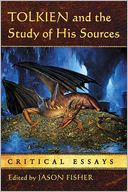
This week marks the fifteenth anniversary of my book, Tolkien and the Study of His Sources: Critical Essays, published by McFarland & Co. The book is still in print and still selling a handful of copies every month, and this seemed like an opportune moment to reflect back on it.
My book was published on July 22, 2011. I originally wanted to call it The Bones of the Ox: J.R.R. Tolkien and Source Criticism, in reference to the dialogue between Tolkien and Sir George Dasent in “On Fairy-stories” (see TSHS, p. 1), but the publisher felt that not having “Tolkien” or “Middle-earth” in the first part of the title might doom the book to obscurity. They were probably right. So I suggested the direct, obvious title the book now has, which I and a few others felt was rather dry — but it does have the virtue of telling you exactly what’s between the covers!
Initially priced at $40, but after some years, the publisher dropped the price to $20. It’s available in both softcover and digital. On Amazon, readers have rated it 4.5/5.0; on Goodreads, it’s 4.02/5.0. It’s in 244 libraries worldwide, says WorldCat. According to the latest data I have from McFarland, the lifetime sales so far are 1,082 softcover plus 556 digital copies, for a total of 1,638. Not many copies by the standards of a popular novel, but for an academic book, I think this isn’t too bad.
Google Scholar returns about 250 hits on the title, suggesting it’s been fairly influential over the years, referenced by quite a few scholars in their own research. That’s just what I envisioned when I wrote, “and for those readers who wish to undertake source studies of their own, it is my hope that this book should stand as both blueprint and encouragement” (TSHS, p. 6). Some academic books have been much more influential — for example, Verlyn Flieger’s Splintered Light returns more than twice as many results on Google Scholar, and Tom Shippey’s The Road to Middle-earth returns more than 1,700. Another way to look at that, though: my book has been referenced half as many times as Verlyn’s! That’s pretty good! Plenty of academic works on Tolkien have registered far less impact, including some well-known titles with only single-digit citation results on Google Scholar. (Which and whose? I don’t want to offend anyone, so as Tolkien would say, ergo silebo.)
In 2014, my book was awarded the Mythopoeic Scholarship Award in Inklings Studies, after being a finalist the two previous years. At the time, it was only the third multicontributor collection in the Mythopoeic Society’s then more than forty-year history to win that award — the one before it a dozen years earlier. Since then, just one other multicontributor collection has joined this small club. My “Aslan” (the engraved lion statue awarded to winners) still sits in pride of place on my bookshelves.
TSHS was notably reviewed in Tolkien Studies, Mythlore, Hither Shore, The Journal of Inklings Studies, Journal of the Fantastic in the Arts, Lembas, Mallorn, Beyond Bree, Mythprint, and Amon Hen (twice, which is another story). I’ll resist the temptation to quote the most flattering excerpts, but suffice to say the reviews were nearly all good. In addition, it was read and favorably blurbed by Verlyn Flieger, Douglas Anderson, and Marjorie Burns.
I also indexed the book myself, which was quite the experience! I took the project very seriously and actually enjoyed it, and I believe I did a good, thoroughgoing job, but it was a big enough chunk of additional work that I haven’t exactly volunteered my indexing services to anyone else every again. (Actually, I did contribute to the indexes for the two books I edited with Salwa Khoddam and Mark R. Hall, including extensive checking and some editing and improvement, but it was Salwa who did the bulk of the compilation.)
I actually placed an Easter egg in the index to TSHS. Has anyone ever found it in the fifteen years since the book was published? Well, no, but that’s only because the publisher removed it in the galley stage, and I didn’t fight them on it. No sense of fun, I suppose! But would you like to know what it was?
The entry in the index was Ovum Gallinaceum Paschae. If you have some Latin, you may know what this means, and therefore implies, but if not, I’ve essentially already said it above: “Chicken Easter Egg”. Why did I include chicken in this? I don’t quite remember now, unless it’s just that I’ve loved and used the English word gallinaceous since junior high school. “Gallinaceous fool” was my version of “Fool of a Took” when I was a youngster. I’ve been an unreformed dictionary diver since childhood! Had it made it to print, the entry would have pointed to the following page numbers in order: 25, 59–60, 76, 82, 113, 124, 126. And now that I’ve told you that, see what you make of it from here! Anyone?


I just cited two of that volume's essay in my forthcoming article in TS. Pretty good staying power, I'd say.
ReplyDeleteSplendid, and thanks! I'll keep an eye out for your essay, and congrats on that!
DeleteI too will look out for that essay!
DeleteCongratulation on 15 years! I still think "The Bones of the Ox" would have been a better title, but I can't argue with the publisher's logic. More importantly, I still consult the essays in the book to this day. It is a crucial contribution to Tolkien scholarship that you should be rightfully proud of.
ReplyDeleteThanks, Doug! I really appreciate that! And I could and will say the same of your book, which is of a similar (slightly older) vintage, and which I also still consult when I need to untangle the complicated textual history of a chapter in The Silmarillion. I've also pointed others to your book many times when they've had questions about the text.
DeleteOne of my all-time favourites, for evident reasons! Congratulations!
ReplyDeleteTa, Marcel! :)
Delete